Sunday, 20 October 2019

19/10/2019 East Grinstead RSPB Group Outing to Dungeness

Saturday 19 October 2019
Dungeness
East Grinstead RSPB Local Group

Despite the awful weather, we took a chance and made the long journey to Dungeness.  Thankfully we were able to complete our tour without getting wet and in the process we saw a couple of really rare birds.

  • 2 of the 3 cattle egrets were showing as we entered the reserve at Boulderwall.   We called back around lunchtime to enable those who missed out the chance to catch up with these lovely creatures.
  • From the Visitor Centre we caught our first sighting of the long staying red-throated diver as it drifted close to us.  A small group of chiffchaffs also caught our attention.
    red-throated diver
    courtesy of David Scott and Twitter
  • Apart from the usual suspects, tufted ducks, teal, wigeon and a couple of sleepy drake pintails, things were quiet so we moved around the site fairly smartly to allow us more time to visit the ARC Hide and the fishing boats where most of the news was coming from. 
  • After lunch we were rewarded with stunning views of the little stint as it moved around the smallest island, only 30-40 metres from the ARC Hanson Hide. 


little stint at ARC pit
courtesy of Martin Jeffree

  •  Also present was a single knot and a single black-tailed godwit.  Surprisingly, it was 13.30 before we found our first little egret of the day.  The only great white egret of the day was seen shortly afterwards.
  • After a fruitless visit to The Desert to look for ring ouzels, we moved to the fishing boats to twitch the rare sabine's gull that had been reported earlier.  The gull was very obliging, flying so close to us that we didn't even need to use our binoculars. 


sabine's gull
courtesy of Plodding Birder and Twitter


sabine's gull
courtesy of Plodding Birder and Twitter


All 13 members were pleased with the visit and there was a real sense of accomplishment at the end.  Our species list of well over 50 included a year tick for me (sabine's gull) and 2 life ticks (little stint and sabine's gull) for most of the others.


Good old "dunge" - you always deliver, even in the worst weather!


Wednesday, 16 October 2019

10/10/19 4 Day Autumn Migration Tour in Norfolk with Marcus Nash Part 2

Autumn Migration Tour  Part 2
Norfolk
Thursday 10 October 2019 to Sunday 13 October 2019

Part 2 of the autumn migration tour with Marcus Nash was plagued by the same windy conditions as last time, with strong south westerlies on 3 of the 4 days. To make things more difficult, we had rain on days 2 and 4. 

Nevertheless we managed to see some terrific birds and enjoy some magic birding experiences.  We visited most of the sites as on the last tour and saw much the same birds but with some noticeable additions.  What follows below are the highlights.


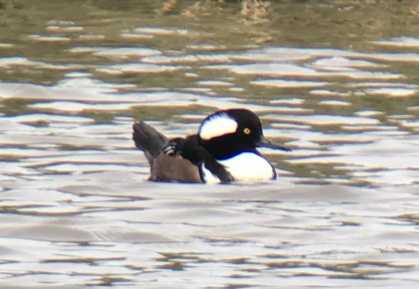
  • Star of the tour was undoubtedly the drake hooded merganser seen by us at Titchwell on day 3. It was first sighted early in the morning, and we learnt that it was still present this afternoon, so we decided to head over there to try to see it.  The car park at Titchwell was already very full as we arrived, with lots of people interested to see this rare bird. We managed to find somewhere to park and headed straight round to Patsy's Reedbed. The hooded merganser was asleep at first over by the reeds at the back but then woke up and swam round a couple of times so we could get a good look at it.  When shooting started in the distance, all the ducks took off and the merganser flew round strongly before eventually dropping back down towards the reedbed pool.


Hooded Merganser
Hooded Merganser - a smart drake, on Patsy's Reedbed
courtesy of Marcus Nash


Hooded merganser is a rare visitor from North America, with only 12 accepted records, although no occurrences before 2000 were accepted. The situation is complicated by the fact that it is very common in captivity and escapes are frequent.

The Titchwell bird showed no signs of having been in captivity - we couldn't see any rings on its legs and it was fully winged.


  • Not far behind in the pecking order was a lovely grey phalarope seen at Thornham Point, just west of the Titchwell reserve, on day 2.  We waited for a lull in the weather before heading out to the sea from the Visitor Centre and turning west to the point.  The phalarope was over at the back of the pool at first, picking around in the samphire. Then it waded into the water and started swimming around, eventually coming right down to the near edge, in front of us.

grey phalarope at Thornham Point

courtesy of Marcus Nash
It was a young bird, a first winter, with some new grey feathers on its back but still with retained darker juvenile feathers on the back of its neck and wings. We could even make out the remains of the creamy orange wash on the front of its neck.
Grey Phalaropes breed in the high Arctic and spend the rest of the year out at sea, migrating down to the coast of South Africa for the winter. They are very prone to be being blown inshore on autumn storms, when they are scarce visitors here. A great bird to see.

 
  • Last time, the yellow browed warblers were just arriving on the north Norfolk coast as our tour finished and I had to be content with a brief glimpse of one in Wells Woods.  Not so this time, they were well established and present in good numbers.   Seeing them was still difficult with the strong winds causing havoc but after a slow start I managed to get several good sightings at Sheringham cemetery, Walsey Hills NR and Holkham Woods.
 

yellow browed warbler
courtesy of Marcus Nash

Arriving from their breeding grounds in the dense forests that stretch from the Urals to eastern Siberia, yellow browed warblers touch down in British woods and scrub, invariably along the east coast, before continuing on a migratory route to who-knows-where. 
 
After first being recorded in Britain in Northumberland in 1838, numbers rose slowly each year to the 1960s when it was no longer regarded as an official rarity, having clocked up 300 sightings. The species is going through a quantum migratory shift. Vast numbers still head to South-east Asia each autumn but a small, slowly increasing vanguard is heading westwards. 
 
 
The best birding experience of the tour was not provided by any rare birds but by the humble siskins and chaffinches. 
  • On our last morning we noticed a huge movement of siskins going west as we were walking through Holkham Woods.  Over the next hour or so we estimated over 2000 had flown overhead and Marcus picked up a report from the seawatchers at Sheringham of over 3500 passing there in a 2 hour slot.  Never before had I seen so many siskins in the air!
  • No sooner had the flow of siskins abated when we noticed a similar build up of chaffinches, again flying overhead along the coast in a westerly direction and numbering at least 2500.  Not quite as many as the siskins but equally stunning and a joy to watch! 

VIZMIG at its very best!
 
 
Here are some of the remaining highlights:-
  • A cracking jack snipe on Snipes Marsh by the car park at Walsey Hills NR on day 3
Jack snipe at Walsey Hills
courtesy of Marcus Nash

  • We had superb views of bearded tits, less than 10 metres away, from the main path by the Island Hide at Titchwell on the last day.  We even had the rare sighting of a cetti's warbler flying with the bearded tits. In front of the hide,  we also had a very obliging water rail looking terrific in the late afternoon sunshine.
male bearded tit at Titchwell
courtesy of Marcus Nash

  • The pink footed geese numbers continue to increase as the autumn progresses!
Pink footed geese
courtesy of Marcus Nash
  • We went down to The Brecks again to see the stone curlews, as none of the rest of the group had seen them gathering communally before.  In all, we saw at least 28 but they were more distant than two weeks ago as they hunkered down to avoid the adverse weather. 
Stone curlews at The Brecks
courtesy of Marcus Nash

  • Among the other birds seen were ring ouzels (poor views I'm afraid), spoonbills, great white egrets, cattle egrets, a couple of yellowhammers, ruff and lots and lots of jays and goldcrests.
  • At Titchwell, just before lunch on day 2, we had the bonus of seeing a water shrew on the path in front of us, feeding on the remains of snails which had been crushed underfoot. They are normally quite secretive, so it was amazing to see one out in the open like this, seemingly completely unconcerned by all the people passing by.
Water shrew at Titchwell
courtesy of Marcus Nash


Another truly great tour, in the most challenging of conditions.  Marcus organised things so that we were actually travelling in the minibus when the weather was at its wettest.


Sunday, 29 September 2019

28/09/19 Thorney Island with Alan P and the Sussex Ornithological Society (SOS) - 2 Ospreys

Saturday 28 September 2019
Thorney Island, West Sussex
Sussex Ornithological Society Outing

Alan P and I joined up with the SOS at Thornham Lane for our annual outing to Thorney Island, hoping to see ospreys on their return journey to Africa. 

Sadly only 6 members made the trip, probably down to the recent inclement weather and the lack of shelter on this 7 mile route.  There was no rain today and it was quite warm despite the blustery conditions. At the start it was almost high tide.


  • We got off to a good start with a noisy cetti's warbler, a chiffchaff and a jay while a flock of 10+ teal flew overhead.  On the pools we saw a good selection of ducks with the usual coots and moorhens.

  • There was little to see by the sea apart from a few redshanks, several dunlin and the 4 turnstones that flew in as we were walking along the sea wall.  The blustery wind (WSW) mitigated against our spotting much as we made our way south along the Emsworth Channel.

  • The highlight of the morning session came when we saw some yellow wagtails among the cattle in the fields just ahead of us.  On closer examination we found there were 20+ of these beauties, sometimes on the ground but frequently taking to the skies in the windy conditions.


Pilsey Island was completely covered by water with no exposed mud/sand so there was no chance to add to our wader count.  As we turned at Longmere Point and headed down the sheltered eastern edges of the island things changed dramatically and our decision to make the trip was vindicated.


  • In the middle of the entrance to the Thorney Channel we saw our first osprey of the day, perched on a pole a few metres from the edge of  the largest shingle outcrop, facing into the prevailing wind.  Despite the attempts of a Mediterranean gull, it held its position and we were able to enjoy great views of this magnificent bird.  
  • A little to the right of the osprey there was a peregrine falcon, hunkered down in the vegetation on the shingle island, sheltering in these difficult conditions.


After close to 30 minutes of prime viewing time we decided to move on. 


  •  There were 2 sandwich terns flying up and down the channel in front of us as well the usual ducks and waders on the newly exposed sand.


The real excitement came at the Great Deep just before the MOD security gates.

  •  On a pole in the distance I could see another osprey, this time perched on a fence pole just away to the left of the canal.  It soon flew to the ground and stayed there for some considerable time, enabling us to get our telescopes zoomed in on to it.

  • While we were observing the osprey we were distracted by the sight of several cattle egrets with the nearby herd of cows.  Eventually, we counted 7 of these lovely birds as they were feeding.

  • Meanwhile, back with the osprey things changed again as the bird took to the air and flew close by us and out into the Thorney Channel. It spent a good 15 minutes or so over the water but, amazingly, it didn't try to catch a fish and eventually returned to its original position.

After almost 45 minutes we decided to draw a close on events and headed back to the car, fully satisfied with our day out. 

For a long time it looked as if we may have chosen the wrong venue and perhaps should have spent the day at Church Norton or Medmerry where the ospreys sightings were being reported earlier.  I should have known better, Thorney Island rarely disappoints and it certainly didn't today - eventually.  The cattle egrets and the yellow wagtails were a bonus, compensating for not seeing any whinchats or rare waders although we did see 3 greenshanks right at the close as we were watching the star birds.


A great day out with Alan and the others, admirably led by "Mr Thorney Island" himself - Richard Senior.


Wednesday, 25 September 2019

22/09/19 3 Day Autumn Migration Tour in Norfolk with Marcus Nash Part 1

Autumn Migration Tour  Part 1
Norfolk
Friday 20 September 2019 to Sunday 22 September 2019

The latest visit to Norfolk provided some excellent birding moments and lots of bird species even though the warm weather and light southerly winds limited the number of migrating birds we were able to find.


Day 1
 
Snettisham
 
  • On the way from our B&B in Wells to the reserve at Snettisham  we saw a little owl on the windowsill of a barn as we passed through Holkham.  Shortly afterwards we saw our fist red kite of the tour. 
     
courtesy of Marcus Nash
A great start!
 
 
At Snettisham we arrived in time for the high tide event.  It was not a Spring tide so not all of the sand was covered meaning the birds did not fly overhead to the nearby gravel pits. Nevertheless they were very close and easily seen in the scope. 
  • As usual, the knot were the star attraction.  Their spectacular aerial formations were simply breathtaking - even now after many years of observing the event. 
  • The supporting cast was very impressive too, with dunlin, oystercatchers, bar-tailed godwits, ringed plovers etc.
courtesy of Marcus Nash

courtesy of Marcus Nash 

  • The pink-footed geese were back in force, several weeks ahead of schedule and they provided a brilliant backdrop throughout.
courtesy of Marcus Nash 

  • On the gravel pits, the best scope view of the day was provided by a spoonbill with 2 spotted redshanks by its side. 
courtesy of Marcus Nash 

  • A single whinchat enjoying the sunshine in the scrub at the southern end of the reserve gave me my first year tick of the tour.

So many birds!
 
 
Titchwell
 

We headed to Titchwell for lunch before starting our afternoon session.
  • Small flocks of brent geese were arriving all the time we were on site.
  • 2 bearded tits, moving along the base of the reeds gave us a superb start to the session.  They were just 20 metres or so away from us as we watched from the island hide The spectacle continued for several minutes, much to the delight of all present.
  • There were scores of ruff on the freshwater marsh.
courtesy of Marcus Nash 

  • As always, we saw several marsh harriers flying low over the reeds.
  • 2 water rails were seen on the marsh.  We normally see these on the main path by the visitor centre.
  • We were keen to find the little stint that had been reported here earlier.  After a short search it was seen moving along the edges of the spit, no more than 50 metres away from us.  From then on we were able to view this lovely wader at leisure.
  • 11 spoonbills flew overhead as we walked along the main path and later on we saw them again as they made the return journey to the marsh.
courtesy of Marcus Nash 

  • On the way back to the visitor centre we stumbled across a migrant redstart which was facing us in the bushes just a few metres away.  It appeared quite unconcerned about our presence; it was probably too tired after a long journey. 
    courtesy of Marcus Nash 
  • Other birds of interest included avocets, common and sandwich terns, a little ringed plover, several Mediterranean gulls, a yellow wagtail, golden plover, a wheatear and lots of dunlin.
We finished the day with a brief seawatch but there was little movement to be seen.

All 9 of us were very, very pleased with our first day!


Day 2
 
The weather was warm again today, reaching 22C by the afternoon.  The winds had picked up too, but once again they were not conducive to bird migration, blowing from the south east. 

We got off to a very slow start but things livened up from the late morning and by the afternoon we were back in full swing and enjoyed some rather special moments.


Wells, North Point
This area, to the east of Wells, was an obvious place to look for migrants but there was nothing new there for us. 

  • The highlight was finding our first great white egret, walking along the edge of the pool ahead of us.  It didn't stay long however as a grey heron flew in and chased it off.


courtesy of Marcus Nash

  • Pick of the passerines was the yellowhammer which showed well at the top of a tree as we returned to the minibus

Cley
  • A quick look around Walsey Hills Nature Reserve proved fruitless.
  • We headed out towards the sea along the east bank but the pools had virtually dried up so there was no chance of picking up new birds there. 
  • Out at sea there were a few gannets, several red-throated divers and a guillemot.

After lunch at the visitor centre we headed into the reserve where our luck changed instantly.
  • A green sandpiper was soon seen on Simmond's Scrape from the Dauke's Hide

courtesy of Marcus Nash
 
  •  We also had good views of a lovely juvenile spotted redshank.
  • We saw 2 greenshank fly into Pat's Pool so we relocated 10 metres or so to Teal Hide where we got excellent close views.
courtesy of Marcus Nash

 
 What we really came for was a curlew sandpiper which had been seen earlier.  Eventually we spotted it at the far end of Pat's Pool but just as we were setting up our scope's it was disturbed by some dunlin and it flew to Simmond's Scrape which we had just left.
  • Back in Dauke's Hide we duly found the curlew sandpiper among the dunlin at the far end of the pool and we finally settled down to enjoy the views. My second year tick of the tour!


The Brecks

One of the highlights of this time of year is the autumn, communal gathering of Stone Curlews down in the Brecks, and it seemed a good opportunity to escape the breezy conditions on the coast and head inland to see if we could find them.  It was a bit of a drive but everyone agreed it was well worth it. 


  • As soon as we got out of the minibus, we could see our first stone curlew out in the bare field ahead of us. 
courtesy of Marcus Nash


  • As we admired its ID characteristics, we could see several more further back near the sparse vegetation. 
  • No sooner had we settled on these when 3 others flew in and then others appeared.
  • By the time we left, the numbers had increased to over 20 and more birds were still appearing. 
  • Had we stayed until dusk I am sure we would have seen close to the 80 birds thought to be present.


Wow!  What a finish.


Day 3
 
Today was even hotter, reaching 27C at one point.  The wind picked up later but it remained dry and bright throughout, despite a forecast of rain in the afternoon.


Burnham Overy
 
As we passed through Holkham on the way to our destination we saw the Little Owl on the same windowsill that we saw it on Friday.

  • Just as we parked the minibus by the road we could see lots of action in the fields in front of us.  There was a small flock of golden plover in the middle and several grey partridge along the back edge.  A red kite flying over the fields soon scattered these birds.  In the distance we could see several cattle egrets. 
Quite a start!
 
  • As we walked along the track leading towards the sea we got better views of the partridges. 
  • A small flock of pink-footed geese flew overhead, followed a little later on by at least 4 newly arrived brent geese.


    courtesy of Marcus Nash
  • Looking over the harbour we could see the usual waders and a single juvenile knot.
  • 2 great white egrets flew over the fields towards Holkham.
  • From the sea wall we got super views of the cattle egrets as they moved among the cows, enjoying devouring frogs from the now depleted pools nearby!  All in all we saw at least 6 of these lovely species.
courtesy of Marcus Nash
It is plain to see that even in my short time birding in this area that cattle egrets and spoonbills are flourishing in much the same way as the great white egrets did before them.
 
  • From the sand dunes we saw a distant whinchat in the vegetation ahead of us and as we turned west towards Gun Hill we got a much closer view of this lovely migrant bird.  It was with a couple of stonechats and a flock of linnets.
  • There was a Lapland bunting calling and soon afterwards it flew by us.  Alas I was one of those who missed it.
 
This has to be my favourite area and I enjoyed the spectacular scenery in almost perfect lighting conditions. 
Normally it would also be a hotspot for migrants. But not today!  There were lots of birds around but most were not new and we had already identified them elsewhere on this tour.
 
  • As we walked back to the minibus the pink-footed geese in the fields took to the air as a marsh harrier came too close, providing us with a spectacular skyline. 
courtesy of Marcus Nash


Holkham Woods
 We had lunch at the new café at the bottom of Lady Anne's Drive, after which Marcus took us into the nearby Holkham Woods.  He had picked up news of some migrants further along the coast, including a few yellow-browed warblers and pied flycatchers. 
  • Despite our best efforts we could not find any!
  • We did get a couple of excellent views of a hobby as it soared over the pine trees.
courtesy of Marcus Nash
  • Other birds included a peregrine, more marsh harriers and more red kites.
 
Wells Woods
 
A very frustrated Marcus then took us to Wells Woods where we enjoyed a welcome ice-cream break before resuming our search for migrants.  This was very unlike Marcus but he told us he now likes to include this type of break after regretting not taking up the suggestion from one of his clients on his recent trip to Greece. 
By this time the wind was picking up considerably, making it much more difficult to follow the tit flocks that were most likely to contain our target birds.
 
  • Thankfully we were rewarded with a brief glimpse of a yellow-browed warbler which called from an overhead tree before flying off. 
Phew!


Another quite excellent trip with well over 100 species seen and some memorable birding experiences. 
 
  • Bird of the trip for me was the stone curlew down in The Brecks.
 
  • Best experience of the tour was, of course, the huge flocks of returning pink-footed geese.


Monday, 16 September 2019

15/09/2019 Back twitching - eastern olivaceus warbler in Hampshire

Sunday 15 September 2019
Farlington Marshes, Hampshire Wildlife Trust


I enjoyed my first twitch since April when I crossed the border into Hampshire today.  On a glorious afternoon, with bright sunshine and no wind, it was a real treat to be by the sea at Farlington Marshes on the outskirts of Portsmouth.

  • A rare vagrant from SE Europe, the eastern olivaceous warbler turned up here yesterday lunchtime just as I was setting off for the Brighton fixture with Burnley at the Amex so I was unable to go then.  Thankfully it stayed and I got my chance today.  
 
  • There must have been over 30 birders in place as I arrived but the bird was not showing.  I didn't have to wait too long before I saw it flitting around the tall bushes  25 metres in front of me.  Eventually I managed to get good scope views of the bird. 

  • The key characteristics for me were the flat forehead and the long narrow bill, coupled with flickering tail movements as it moved about. 

courtesy of Simon Colenutt and twitter


  • After that it was just a case of waiting and enjoying the repeating pattern of the bird disappearing into the scrub and then reappearing soon afterwards. 
  • courtesy of Matthew Deans and twitter 

A relatively easy twitch, with good views of a bird that reminded me a lot of a reed warbler.
 
    A "lifer" for me, my sixth this year and number 353 on my life list.