Friday, 12 October 2018

12/10/2018 Day 2/4 in Norfolk with Marcus Nash: Into the Brecks and the Broads

Friday 12 October 2018
Day 2/4 Marcus Nash Norfolk Trip.
Into the Brecks and the Broads

The main highlights today are listed below:-

Perhaps the most pertinent detail relates to the weather, with very strong winds prevailing which made for some very difficult birding.
  • bird of the day was undoubtedly the Stone Curlew with at least 14 sightings on the pig farms just south of Swaffham.
  • 2 Pectoral Sandpipers showed well at Buckenham Marshes.
  • check Marcus' report for a partially-failed twitch on a housing estate in Norwich. Thankfully it was of  a  Rose-coloured Starling and I had already seen one in the spring at Dungeness.
  • a Yellow-legged Gull at the Swaffham site was a new addition to my year list.
  • I saw my first White-fronted Geese of the autumn at Buckenham Marshes.
 A full report from Marcus is shown below.
 

12th Oct 2018 – Four Autumn Days, Day 2

by The Bird ID Company
Day 2 of a four-day Autumn Tour today. It was rather cloudy all day and very breezy again, but at least it stayed dry. With birds we wanted to try to see in the Brecks and down in the Broads, we decided to venture further afield today.
Our first target for the day was Stone Curlew. At the end of the summer, they gather together in big post breeding flocks in the Brecks. Numbers typically peak in September and start to decline in October as birds move off for the winter, but we figured we should still be able to find some of them here.
As we drove down the road, we could see several birds in the field the other side of the hedge and a glance over confirmed that there was a mixture of Stone Curlews and Lapwings. Unfortunately there is nowhere to stop here, so we continued on to try another site, in the knowledge that we could always come back if need be.
Stopping at a gate overlooking a large area of open fields, we quickly located two Stone Curlews. They were some distance over and facing away from us, into the wind, sheltering behind a line of green vegetation. Still it was a good start and we had a look at them through the scopes, so we could make out their staring yellow irises and short, black-tipped yellow bills.
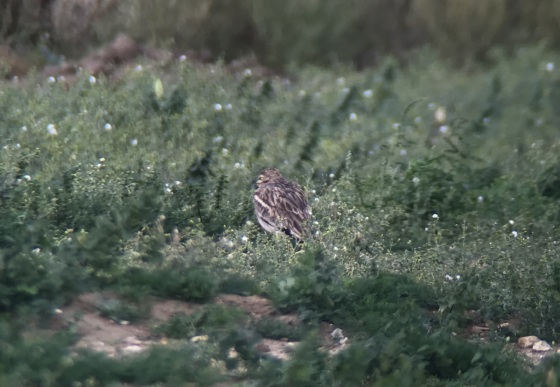
Stone Curlew 1
Stone Curlew - we found two at the first place we stopped to scan

As we stood here watching the Stone Curlew, several small flocks of Song Thrushes, Redwings and Skylarks flew over our heads. As we had seen yesterday, birds were on the move again today - with their migration visible even down here in the Brecks.
With Stone Curlew in the bag, we decided to have a go and see if we could find a closer one. We drove over to another field they have been favouring this autumn. The weedy vegetation here has grown up in recent weeks and there are more places to hide, but it didn't take long to find another Stone Curlew, this one much closer than the two we had seen earlier. We edged along the path beside the field so as not to disturb it, to where we could set up all the scopes and admire it.
While everyone had a good look at this Stone Curlew in the scope, we scanned the vegetation more carefully. On each sweep, we located another one hiding in the weeds until we had found at least four Stone Curlews here. Looking out to the bare stony ground beyond, we spotted another four Stone Curlews hiding up against a small ridge of earth.

Stone Curlew 2
Stone Curlew - we found several closer ones at the next place we stopped

After getting great views of the Stone Curlews, we decided to scan the pig fields nearby. In the first field, several Egyptian Geese were walking around the pig troughs in the middle. A Stock Dove flew in and dropped down out of view with the Woodpigeons in the middle.
At the second set of pig fields, we could see a very large flock of gulls asleep in the middle. They were almost entirely Lesser Black-backed Gulls, along with a few Black-headed Gulls and a single Common Gull. Scanning through them more carefully, we could see a larger gull asleep, half hidden in with the Lesser Black-backed Gulls. It had a paler mantle, a bit too dark for a Herring Gull, and through the scope we could see its comparatively plain white head, with just a few pencil streaks,  When it opened its eye, it had a pale iris and a noticeable reddish orbital ring. It was an adult Yellow-legged Gull.
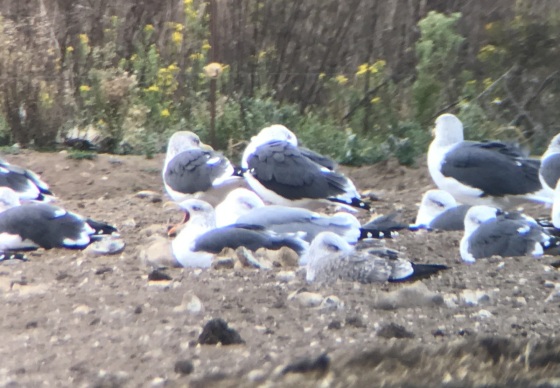
Yellow-legged Gull
Yellow-legged Gull - asleep in with the Lesser Black-backeds

It felt like it was brightening up and for a second we could feel a bit of the sun's warmth in the air. Combined with the brisk wind, we thought it might be a good day to try to see a Goshawk up enjoying the breeze. On our way round, we stopped briefly to look at a flock of Chaffinches in some small bushes by the road and found two Bramblings in with them.
By the time we got round to a high spot overlooking the forest, the warmth in the air had disappeared again and it was back to cold, grey and windy. As we got out of the car, it was clear there was very little aerial activity over the trees and it didn't help that there was a pheasant shoot under way a couple of fields over which was very noisy and causing a lot of disturbance, with vehicles and dogs along the edge of the trees.
A Mistle Thrush flew across over the edge of the trees in front of us, and two unseasonal House Martins circled over - most of them have already left, off to Africa for the winter. We stood and watched for a few minutes and a few Common Buzzards circled up over the trees but never gained much height. A Sparrowhawk shot across, skimming above the treetops. We had a lot of ground we wanted to cover today, so we decided to move on and get away from the noise!
There has been a Rose-coloured Starling lingering on a housing estate on the outskirts of Norwich for the last few days, so on our way across to the Broads, we decided to call in for a quick look. It turned out it had been hiding in the back garden of one of the houses today, not visible from outside, but the homeowner was very kindly letting people in for a quick look whenever it appeared on the lawn. Unfortunately, it was only coming down to feed every 20-30 minutes and then only lingering there very briefly.
When we arrived, there were already several people waiting. Not long afterwards, the Rose-coloured Starling reappeared down on the lawn, the front door opened and everyone rushed in for a look. Unfortunately, due to the viewing angle, only the first few people inside could see the lawn where the bird was feeding. Only half the group got a quick look at the Rose-coloured Starling, before it flew up and disappeared into the hedge again.
We filed back outside and waited to see if there might be another showing, but it looked like the homeowner had taken a break for lunch and was no longer keeping an eye on the garden, so we decided to head on elsewhere instead.

Gadwall
Gadwall - the connoisseur's duck, on the pool by Reception Hide

It wasn't too far from here to Strumpshaw Fen, where we stopped for our lunch on the picnic tables by Reception Hide. The front of the pool was packed with ducks, mostly Gadwall which we stopped to admire, along with a few Mallard and a couple of Teal. The resident feral Black Swan eventually appeared with the Mute Swans, before swimming over to the front and climbing out onto the bank to preen. A couple of Marsh Harriers circled over the reeds beyond.
A steady stream of Blue Tits and Great Tits were coming in to the feeders. A sharper call alerted us to a Marsh Tit which shot in, grabbed a sunflower seed and flew over to an elder bush nearby to eat it. It came in several times over lunch, at one point joined by a second Marsh Tit, giving us a chance to get a good look at them. A Siskin flew over calling too.
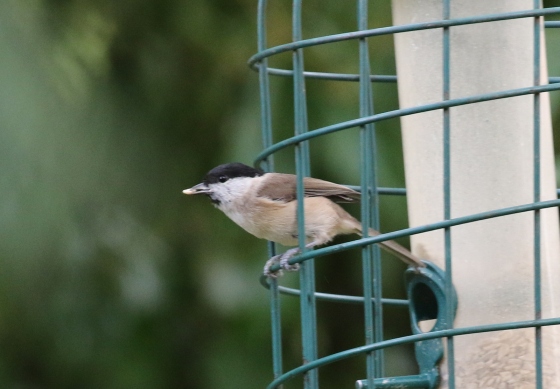
Marsh Tit
Marsh Tit - two kept coming in to the feeders over lunch time

After lunch, we headed round to Buckenham Marshes. As we drove down the road, a Red Kite was hanging over one of the fields and was we crossed the railway line, two more appeared over the grazing marsh right in front of us.

Red Kite
Red Kite - one of two, over the grazing marshes

Scanning from the gate, we could see a few geese out on the grazing marsh and through the scopes we could see there were several groups of Canada Geese and Pink-footed Geese, along with a smaller number of Greylags. There had been a report of White-fronted Geese here this morning, but we couldn't see them at first.
As we walked down the track towards the river, we could hear them calling and looked across to see a family of three White-fronted Geese out on the grass. They were presumably just returned here for the winter, as they were calling regularly and very mobile, flying round between the different patches of marsh. Through the scope we could see there were two adults, with white surrounding the base of their bills and black bars on their grey bellied, and a juvenile which lacked those.
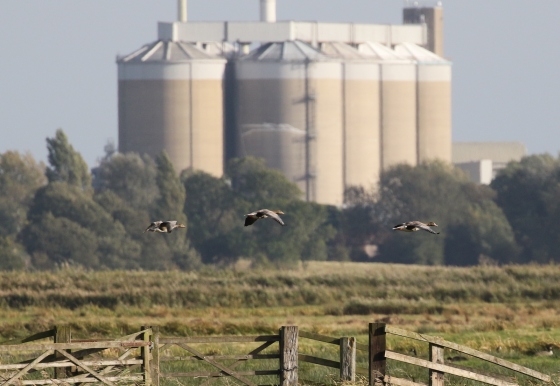
White-fronted Geese
White-fronted Geese - a family of three, just returned for the winter

These were the first White-fronted Geese we have seen this autumn, and should be the first of many to return to the marshes here, where a few hundred normally spend the winter.
A flock of Barnacle Geese flew in next, circling round over the marshes before dropping down to feed with the Canada Geese. These are feral birds, which also spend the winter here. Despite their non-wild origins, they are still beautiful geese, so we did have an admiring look at them through the scopes.

Barnacle Geese
Barnacle Geese - this flock flew in and landed with the Canada Geese

While we were watching the geese, a Common Snipe flew up from the edge of the ditch in front of us and zig-zagged off away over the marshes. There were a couple of Chinese Water Deer out in the grass too.
Continuing on along the track, we stopped to scan the pools over towards the river bank. There were lots of ducks here, mainly Wigeon and Teal, along with a few Shoveler. This is a very important site for wintering Wigeon, but there are still a lot yet to return here from their Russian breeding grounds.
We had really come here to look for waders, and in particular two Pectoral Sandpipers which have been on the pools here for the last few days. We could see a little group of Ruff, including a winter satellite male with a striking white head, and several Dunlin. Through the scopes, it didn't take long to find first one and then the second of the Pectoral Sandpipers, feeding on the mud along the edge of the vegetation just behind the water.

Pectoral Sandpiper
Pectoral Sandpiper - one of the two juveniles at Buckenham

We had a good look at the Pectoral Sandpipers from the gate on the edge of the marshes. It was a bit windy out here, but we could see they were both juveniles, with neatly pale-fringed dark feathers in the upperparts. We could see there distinctive streaked breasts, sharply demarcated against their white bellies in a neat pectoral band. They were abot the same size as the Dunlin, but with shorted bills. There were several more Common Snipe feeding on the edge of the vegetation near them too.
Continuing on to the river bank, we had another quick look at the Pectoral Sandpipers from the shelter of the hide. It was a bit further away, but out of the wind. Then it was time to head back, with a long drive ahead of us.

Thursday, 11 October 2018

11/10/2018 Day 1/4 in Norfolk with Marcus Nash: Yellow-browed Warbler

Thursday 11 October 2018
Day 1/4 Marcus Nash Norfolk Trip
Around the Wells Area.

The main focus of the day was Yellow-browed Warblers and we were lucky to encounter them on at least 6 occasions, with good views on 2 of these. More about this later.

We spent the morning in Wells Woods and the afternoon on the east side of Wells as far as Warham.  After a wet start, the clouds lifted and the rest of the day was glorious sunshine and clear skies.  However ….  the winds were ever-present, typically  30 m.p.h., making life very difficult for us.

The main highlights were:
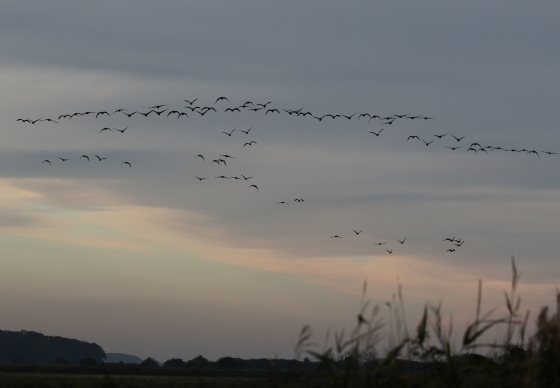
  • My first views of the newly arrived Pink-footed Geese from Lady Ann's Drive was a brilliant start to our day.
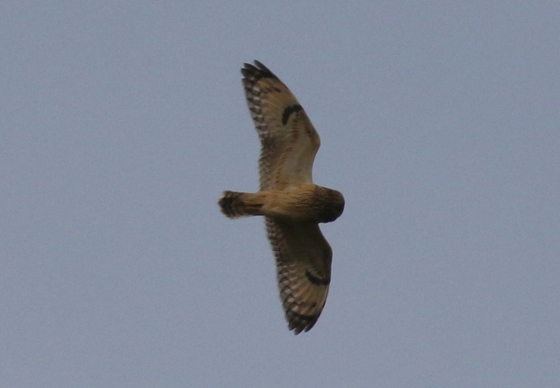
  • A migrant Short-eared Owl flew in as we watched from Wells Woods.
  • Viz Mig was much in evidence - the majority of which was birds arriving from Scandinavia - mainly Thrushes, Chaffinches, Bramblings and Crossbills.
  • Bird of the day was the Yellow-browed Warbler which led us a merry dance but ultimately gave us good views.  The strong winds made things difficult as we followed the tit-flocks and we eventually struck lucky on the more sheltered north (seaward) side of the wood.
  • A couple of excellent views of a Hobby flying overhead.
  • Several good views of a ringtail Hen Harrier form the east side of Wells were much appreciated.
 A full report from Marcus is shown below.


11th Oct 2018 – Four Autumn Days, Day 1

by The Bird ID Company
Day 1 of a four-day Autumn Tour today. After a damp and cloudy start, the skies cleared and it was bright, sunny and even quite warm. After heading out with coats and hats, we were desperately shedding layers by mid-morning! There was a rather blustery south wind all day, which meant some of the smaller birds were keeping down in cover though.
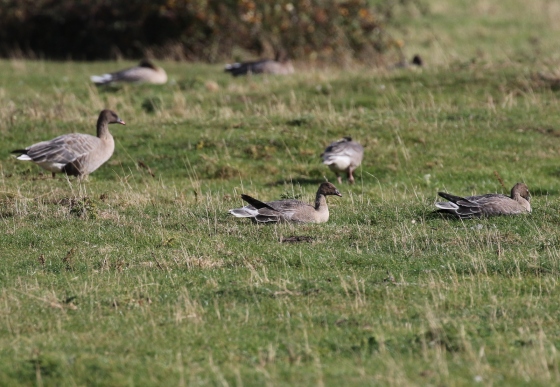
We started the day at Holkham. Parking at Lady Anne's Drive, we could hear Pink-footed Geese calling as we got out of the car and several small skeins came over up off the grazing marshes and flew off over our heads, heading out to feed from where they had probably roosted last night.

Pink-footed Geese 1
Pink-footed Geese - flying off from the grazing marshes early morning

At the top of Lady Anne's Drive, we turned left on the path which runs west on the inland side of the pines. We hadn't gone more than a couple of metres before we heard a Yellow-browed Warbler calling in the trees. It came into a large oak above our heads but was high up in the leafy branches and proved impossible to see in the early gloom and wind.
A second Yellow-browed Warbler called from the holm oaks the other side of the tracks. We could see movement in the dark leaves, but it moved through too quickly to get on and both birds went quiet. We decided to try again later, if need be, when it had brightened up a bit. A good start, with two calling Yellow-browed Warblers, anyway.
A little further along the path, we came across a flock of Long-tailed Tits feeding high in the tall poplars. We stopped for a minute to see if we could find anything else with them. There were some other tits, including a couple of Coal Tits, and we heard Goldcrest and Treecreeper calling, but they moved quickly up into the tops of the pines and disappeared deeper into the trees.
At Salts Hole, there were at least six Little Grebes around the pool, back for the winter. A lone Curlew was feeding in the field behind. There were lots of Jays out today, busy collecting and stashing acorns, and we saw three flying across the back of the pool, between the trees.
We stopped again at the gate just before Washington Hide, to scan the grazing marshes. The first thing we noticed was a Short-eared Owl, circling high above the grass, flying with its distinctive stiff-winged action. It seemed nervous, looking round, possibly fresh in over the sea from Scandinavia. It flew back towards the pines and disappeared over the trees.

Short-eared Owl
Short-eared Owl - out over the grazing marshes, possibly a fresh arrival

A Cetti's Warbler singing in the edge of the reedbed was good to hear, having lost most of our resident birds over the cold weather last winter. A Marsh Harrier was circling over the reedbed too, a dark chocolate brown young bird with green wing-tags, presumably tagged in the nest here. It was joined by a male and the two of them grappled talons briefly.
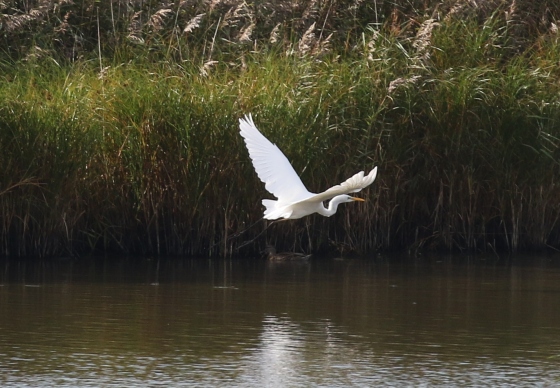
A Great White Egret flew in and seemed to land down on the pool, hidden in the reeds. From up on the boardwalk, we could see it perched on a post. It quickly dropped down and we watched it fishing in the shallow water from the comfort of Washington Hide. After a few minutes, it flew off round the back of the reeds.

Great White Egret
Great White Egret - fishing on the pool in front of Washington Hide

There was quite a bit of raptor activity visible from here this morning, as well as more Marsh Harriers, we saw a couple of Common Buzzards, including a rather pale bird perched out in one of the bushes on the grazing marsh, a Kestrel hovering out over the grass, and a distant Sparrowhawk circling.
As we carried on west, we could hear lots of Song Thrushes ticking in the trees - there had obviously been a large arrival of them overnight. There were Chaffinches and Bramblings calling overhead too, also freshly arrived for the winter. We heard a couple more flocks of tits from the path, but they were very hard to see in the wind, even if it was now brightening up nicely. They seemed to be hiding up in the pines or in the denser holm oaks, rather than out in the deciduous trees by the path.
At the cross-tracks, we came across another flock and could hear several Chiffchaffs calling here too, with them. Another Yellow-browed Warbler called from just into the trees, so we walked in along the path, but by the time we got round to where it had been the tits had disappeared up into the pines again.
We decided to carry on through to the north side of the pines, where it would be more sheltered from the wind. A Grey Wagtail flew over calling, but we couldn't see it from deep in the trees. As we emerged from the pines, we flushed several Song Thrushes which had been feeding down on the grass, rather grey-brown birds from the continent, duller than our resident Song Thrushes.
We heard yet another Yellow-browed Warbler calling, but this time it was out in the scattered pines in the open dunes, so we figured we had a chance of getting a look at this one. Thankfully it was quite vocal, presumably another fresh arrival, and we managed to track it down. Eventually almost all the group got a good look at it, as it flitted around among the branches. A second Yellow-browed Warbler was calling in the woods, from the denser pines beyond.
As we walked a short distance through the dunes, more Song Thrushes were coming in overhead in singles or small groups. A little flock of Bramblings flew in overhead, and we heard a small group of Crossbills glipping as they flew west over the pines, although we couldn't see them above the trees from this angle. A couple of Stonechats were perched on the top of the brambles in the dunes.
Climbing up to the top of the dunes, we stopped to scan the sea. There were quite a few birds out in the bay today - several Red-throated Divers, a Great Crested Grebe, a Guillemot, and a raft of Common Scoter. A Sandwich Tern flew past offshore, presumably a lingering summer visitor, as did a few small lines of Brent Geese, just arriving back from Russia for the winter.
It was quite amazing to just stand here looking out over the sea and just watch the birds arriving in from the continent. In particular, we saw lots of Skylarks coming in, with several flocks flying up over the dunes past us and in over the pines and other groups continuing on west just offshore. A Red Kite circling out over the beach may have been on the move too, before coming in over the dunes past us.
It was windy again back on the south side of the pines, and harder to see the birds again. We did hear several Redwings calling in the trees, and eventually got good views of one perched in the top of a pine tree. Several Song Thrushes were feeding up on the berries in a hawthorn bush, after their long journey.
Continuing on out of the pines at the west end and into the dunes, we flushed lots more Song Thrushes from the bushes as we passed. A Blackcap was calling from the brambles but we didn't see it. Up on the top of the dunes, we heard a Redstart calling in a hawthorn bush. As we walked round the back, it flew across and disappeared into a dense clump of privet. Two Grey Herons flew in high over the beach, more migrants just arriving for the winter.
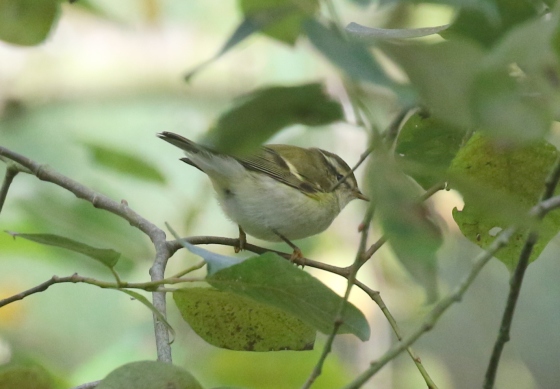
Yet another Yellow-browed Warbler called and we turned to see a couple of people looking into a holly bush out in the dunes. The bird was remarkably hard to see, despite it being just a very small bush, but eventually it came out onto the more sheltered side to those members of the group who hadn't seen the Yellow-browed Warbler earlier could finally get a good look at one.

Yellow-browed Warbler
Yellow-browed Warbler - one taken a couple of days ago in the woods

These tiny warblers breed over in Russia, just west of the Urals, and should be migrating south east to winter in Asia. Instead some Yellow-browed Warblers head off west and arrive on our shores. They used to be very rare here, but in the last twenty years have become regular visitors at this time of year. Still, they are always a pleasure to see and to marvel at their remarkable migration.
It was already after midday and stomachs were starting to rumble, so we headed back towards the car. It was lovely and sunny now, and warm too if still rather breezy. There were lots of dragonflies along the path in the more sheltered spots, Migrant Hawkers and Common Darters. We saw several butterflies out too, Red Admirals on the brambles, a Speckled Wood and a Small Copper.
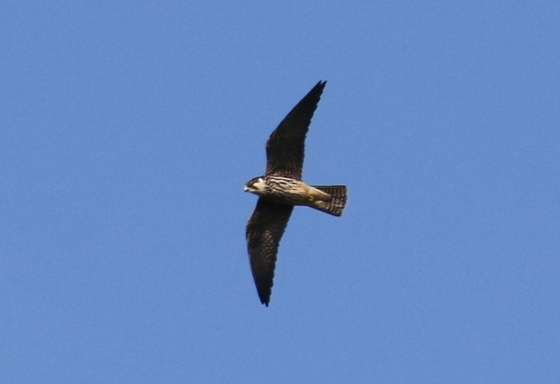
A Hobby was patrolling along the edge of pines, taking advantage of the updraft from the wind, probably looking for dragonflies. A couple of times it passed by over us, and we could see its swept back pointed wings and orange trousers.

Hobby
Hobby - patrolling along the edge of the pines

Surprise of the day was a Kingfisher which flew over our heads as we walked back along the path on the edge of the pines - not normally where you expect to see one, although they are often seen out on the marshes here. Almost back to Lady Anne's Drive, we ran into another tit flock and this time got good views of a Treecreeper climbing up a tree trunk.
It was time for a late lunch when we finally got back to the car. There were lots of Pink-footed Geese still loafing around in the fields alongside Lady Anne's Drive, while we ate. Afterwards, we set off to explore the coast east of Wells.

Pink-footed Geese 2
Pink-footed Geese - loafing in the fields by Lady Anne's Drive over lunch

The wet fields east of Wells by the coastal path are full of wildfowl a the moment. We could predominantly see big numbers of Wigeon and Teal, the drakes still mostly in their dull eclipse plumage. In amongst them we found a single Pintail too. There are lots of geese here, but Greylags, Canadas and Egyptian Geese, although we saw plenty of Pink-footed Geese passing overhead calling.
There were a few waders in with all the wildfowl. We could see several Ruff feeding in the long grass around the pools, along with a small number of Lapwing, and three or four Black-tailed Godwits in the edge of the water, hiding in amongst all the Wigeon.
A large flock of Linnets and Greenfinches was feeding in the edge of the field nearby and further back we could see a couple of bright male Yellowhammers perched up in the bushes catching the sun. As we walked down along the track between the pools, we flushed several Reed Buntings from the wet grass. A pair of Stonechats flew along the fence line ahead of us, perching on the posts or on the bushes either side.

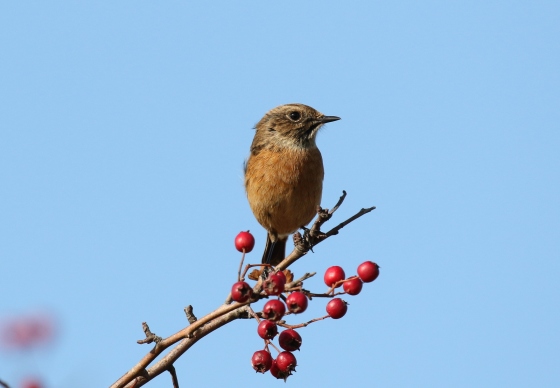
Stonechat
Stonechat - a pair flew along the path ahead of us

At the next pool we came too, we were looking into the sun and it was hard to keep the scopes steady in the wind. All we could find here today were Teal and Mallard, sheltering in the grass around the edges. There were lots of Little Egrets and Curlews out on the saltmarsh the other side and a couple of Redshank down in one of the muddy channels.
We decided to have a walk on along the coast path to finish the day. There were still more Song Thrushes and Chaffinches coming in, little flocks flying in over the saltmarsh and disappeared inland over the fields, or flying over our heads heading west along the coast. But there were few migrants in the bushes by the path this afternoon - as well as being windy, there were lots of people and dogs out for a walk and it was probably a bit too disturbed here.
As we walked, we stopped periodically to scan the saltmarshes. We could see several Marsh Harriers circling out in the distance, and eventually we were rewarded with a Hen Harrier too, a ringtail. We stopped and watched it as it quartered low over the marsh, flashing the white square at the base of its tail as it turned. A second Hen Harrier appeared briefly, away to the east in the distance, but didn't come our way. After a while, the first dropped down into the vegetation.
We continued on as far as Garden Drove, but the trees at the north end were more exposed to the wind, and it was hard to see anything in here. We could hear Long-tailed Tits calling and saw them as they flew out of the trees and headed off inland along the hedgerow. There were a few other tits with them, but we couldn't see anything else.
Unfortunately we didn't have much time here, as we had to get back and a couple of members of the group had decided to stop on the path where we had seen the Hen Harrier rather than continue walking, so we didn't want to leave them too long. The Hen Harrier was up again, quartering the marshes as we got back.

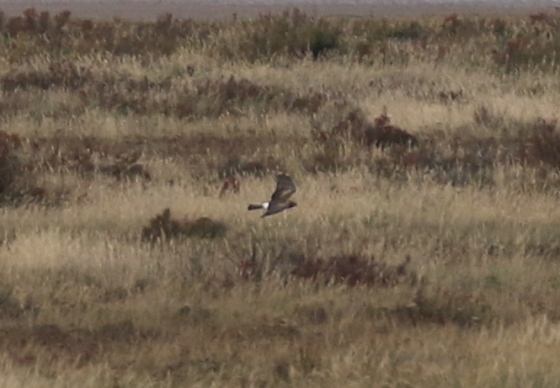
Hen Harrier
Hen Harrier - a ringtail, quartering the saltmarshes

It was a nice way to end our first day out, watching the Hen Harrier out over the marshes. Let's see what tomorrow brings...


Wednesday, 10 October 2018

10/10/2018 Spotted Crake at Wilstone Reservoir in Hertfordshire

Wednesday 10 October 2018
Wilstone Reservoir, Hertfordshire

  • I finally got round to twitching the Spotted Crake in Hertfordshire this afternoon.  This rarity didn't show until 17.45 - more than 2 hours after I arrived. 
The wait was well worth it with the bird providing some splendid views as it moved along the edges of the reedbed foraging for food. The Indian summer conditions also provided an enjoyable interlude while I waited patiently for the bird to appear.

Another very enjoyable twitch!

Monday, 8 October 2018

07/10/2018 Rye Harbour NR and Pett Level with the East Grinstead RSPB Group

7 October 2018
Rye Harbour NR and Pett Level, East Sussex
East Grinstead RSPB Local Group

A thoroughly enjoyable day out with my RSPB group today, initially at Rye Harbour NR and then on to Pett Level later on.  Great weather, great company and at least 53 species seen.  Nothing spectacular, no new sightings - just a darn good birdwatching experience.
  • Pick of the sightings was an attractive Greenshank.
  • The only sign of visible migration was a steady passage of Brent Geese throughout the day.
  • The remaining 50+ birds showed frequently throughout our trip, to keep us interested and on our toes.

Great fun!


Wednesday, 3 October 2018

03/10/2018 Ferruginous Duck at Blashford Lakes in Hampshire

Wednesday 3 October 2018
Blashford Lakes, Hampshire

I was on the road again this afternoon - this time into Hampshire to twitch the drake Ferruginous Duck at Blashford Lakes.

I thought I had better go now because any day soon it will move to Kingfisher Lake as it has done in recent years.  Seeing it on the private Kingfisher Lake is much more difficult, of course.

The Wood Sandpiper and the Great White Egret were welcome bonuses.


Well worth the trip.

Tuesday, 2 October 2018

01/10/2018 Red-backed Shrike at Thorney Island

Monday 1 October 2018
Thorney Island , Sussex

With the golf reaching a nail-biting finale yesterday, I decided to delay my trip to Thorney Island until today.
  • this was another very easy twitch with the Red-backed Shrike showing really well on top of the bushes by the security gates near the Great Deep.

A nice afternoon by the sea.

Saturday, 29 September 2018

29/09/2018 Buff-breasted Sandpiper at Scotney Court Farm in East Sussex

Saturday 29 September 2018
Scotney Court Farm, East Sussex


Finally tore myself away from watching the golf during the foursomes.

If the Grey Phalarope at Bough Beech was an easy twitch last week, this one was tough!
  • I had to wait until 17 45 to get a decent, if distant, view of the Buff-breasted Sandpiper in the field just south of the waters to the west of Scotney Court Farm, - well over 2 hours after I arrived on site. 
  • Excellent company.

Patience is a virtue. 
A superb Sussex evening - I didn't want to leave!