Monday, 2 December 2019

01/12/2019 Hawfinches at Penhurst Lane near Battle, East Sussex

Hawfinches at Penhurst Lane near Battle in East Sussex

Fired up by Mark Mallalieu's presentation to the East Grinstead RSPB Group last Wednesday, I spent time at Penhurst Lane looking for hawfinches. 


Friday 29 November
 
  • I arrived at the site just before 2 pm to find Cliff Dean and his group from Rye looking for these birds too, but having no luck.  They were moving from the area by the post box towards the second viewing point by the metal gates near the public footpath in front of the woods. 
  • I and another birder from his group stayed at the post box so that we had both bases covered.  Try as we may, however, there was no sign of any hawfinches.
  • I did see a cracking grey wagtail on the roof of one of the cottages by the nearby pond. 
  • We also heard then saw a goldcrest in the trees behind us

Saturday 30 November 2019

I tried again the following day but was a little late, getting there around 2.45 pm. 
  • I met up with David Williams and another young birding couple.  They had seen as many as 15 hawfinches from the post box area, including a couple of stunning close views before the birds flew north towards the metal gate viewing point.
  • I stayed behind while they relocated but after a fruitless watch I joined up with them again.  Unfortunately there were no further sightings .

I had missed the action by about 15 minutes!


Sunday 1 December 2019
 
My third attempt was more successful. 
  • After a very early lunch, I arrived on site around 1.45 pm, to join a lady birder by the post box. 
  • Within minutes each of us spotted separate hawfinches.  Hers was the nearest, showing very well in the canopy of one of the deciduous trees just to the west of the road.  Mine was showing a little further away, towards the north west  and again, sitting proud in the canopy of another bare tree.  


  • We were joined by David Williams and then enjoyed uninterrupted views for 30 minutes or so.
  • A later visit to the metal gate area proved unproductive.
  • No success in finding the roost site.


Very pleased to see hawfinches are still in this part of the county after the "invasion" in the winter of 2017/18.


Thursday, 28 November 2019

27/11/2019 East Grinstead RSPB Local Group Meeting Mark Mallalieu on Hawfinches, Goshawks and Honey Buzzards in Sussex

Wednesday 27 November 2019
East Grinstead RSPB Local Group Meeting

  • It was a pleasure to listen to Mark Mallalieu talking about Hawfinches, Goshawks and Honey Buzzards in Sussex at last nights meeting. 
  • It is so refreshing to meet a local talented birder who is both helpful and only too pleased to share his knowledge of these rare birds with the rest of us.
  • I knew of him by reputation but this was the first time I had met him in person. The advice he gave and his offer to help other birders was a pleasant surprise and a breath of fresh air.

Delighted to see a packed audience for this event despite the awful weather around.


Monday, 18 November 2019

17/11/2019 East Grinsteas RSPB Outing to Fishbourne Creek (am) and The Burgh (pm)

Sunday 17 November 2019
East Grinstead RSPB Local Group


"Make hay while the sun shines"

That was our mantra as we took advantage of a break in the recent awful weather to venture down to West Sussex to enjoy a good day's birding.  13 members met up near the Crown & Anchor pub at Dell Quay to spend the morning looking for birds on Fishbourne Creek before relocating to higher grounds at The Burgh for the afternoon session.


Fishbourne Creek
 

We managed to see a creditable 48 species as we wandered down the creek following the waders as the tide came in.  The highlights are listed below:-

  • We were greeted by a sparrowhawk flying overhead as we assembled at the car parking area.
  • There were at least 4 spotted redshanks around.
  • It was lovely to see 2 kingfishers.  Both were initially flying around.  They then settled on the moored boats, providing us with excellent scope views.
  •  4 yellowhammers added to the glamour of the occasion.
  • Other birds included grey plover, golden plover, dunlin, ringed plover, lapwing, redshank, oystercatcher, black-tailed godwit, teal, wigeon etc.


The Burgh
 
We managed to push the species count up to 63 with the birds we saw in the afternoon session.  The highlights are listed below:-
  • Bird of the day was the fabulous ring-tailed hen harrier that we saw several times during our visit.
  • Red kites are staples here and we saw several including a stunning bird that came close to our party.
  • There were buzzards and kestrels around too.
  • There were not many partridges showing but we did eventually see 3 grey and one red-legged.
  • Passerines seen included lots of linnets, goldfinches, fieldfares and long-tailed tits as well as at least 1 goldcrest.


A smashing trip - just the job for our group after the very limited birding opportunities of late.


Thursday, 14 November 2019

14/11/2019 Serin at Cedar Farm, Ticehurst, East Sussex

Thursday 14 November 2019
Cedar Farm, Ticehurst, East Sussex

Another afternoon jaunt, this time north east to Ticehurst on the Sussex - Kent border to see a Serin at Cedar Farm.  The weather was awful with lots of rain but thankfully there was a break around 3pm and I was able to do the twitch.

  • Thanks to the very helpful owner, Malcolm Phillips, I was soon appraised of the favourite place of the serin and although it was not showing at the time it did put in an appearance about 15 minutes later. 


courtesy of Lee Evans and Twitter

  • It was feeding on the ground some 15 metres away and remained in this close position until the next heavy shower came before disappearing again.  


courtesy of Malcolm Freeman and Twitter


  • It's a juvenile, male, bird which the owner first noticed on Tuesday before posting the sighting  on RBA and Birdguides.  Surprisingly, I was only the 6th person to respond.

  •  Serins have been recorded annually in the UK in small numbers since the 1960s and have bred sporadically since the 1970s (Devon, Dorset, Sussex, East Anglia and the Jersey) but no more than one or two pairs a year.
  • Records of serin have almost entirely been from southern and eastern England, but they have never been present in large numbers.
 
Serin distribution map
 

  • Most recorded sightings of serin are in April and May, although it has been recorded in the UK in all months.
  • It breeds across southern and central Europe and north Africa. Southern and Atlantic coast populations are largely resident, but the northern breeders migrate further south in Europe for the winter.


Another good sighting and well worth the short, but tricky, car journey.

Wednesday, 13 November 2019

13/11/2019 Great Bustard (code 92) near Seaford, Sussex

Wednesday 13 November 2019
Seaford , East Sussex

It's not often you get the chance to see a Great Bustard in Sussex.  In fact the last one was seen over 100 years ago.  So it was a no brainer for me to go to see this bird in a kale field between the villages of Bishopstone and Denton, near Seaford. 

I parked in a lay-by on the Bishopstone Road before walking up the hill to join the main footpath from Bishhopstone to Denton.  From this elevated position I could see the bird feeding at the bottom of the hill just in front of the Stud Farm.  It was bright and sunny so the views were excellent.

On returning to the car I met a Kent birder who I had met earlier. He had been looking in the wrong place for the bird.  As it was getting late, it was easier to take him to the viewing point.  From there, using my scope, he too was able to enjoy the views and I was rewarded with a second helping.


When I got home I checked out the history of this bird. 

  • It was first seen on 6 November by Simon Linington, leading a Sussex Ornithological Society walk at Birling Gap.  The bird flew in from the east, much to the astonishment of the 13 in the group.
  • The bird landed in a nearby field and for well over an hour many local birders were able to get down to the coast to see it. 

courtesy of Simon Linington and the SOS


  • It then flew off again heading west. 
  
courtesy of Matt Eade and Twitter

  • The Bustard was next reported on a Seaford residents Facebook group on 8 November.   A non-birder found the bird and described it so well that its ID was soon established.  Without this information, it is highly likely the bird would not have been seen again as the South Downs around Bishopstone is a very underwatched area.
courtesy of Andy Wilkes and Twitter


The bird had a red ring on its left leg, coded 92, although I was unable to see it myself because of the tall vegetation.  From this code the full history of the bird became apparent.

  •  Code 92 placed the bird as one of the Wiltshire Great Bustard Reintroduction Scheme birds.....
  • ... it is a young female....
  • … just shy of 6 months old ….
  • …and hatched from an egg brought in from Spain last summer....
  • it hasn't been seen in Wiltshire for a couple of weeks.

Word has it that no more imported eggs are planned after this year as the 100+ birds currently here represents an almost self sustaining population.  Great news!


Its a fascinating prospect that here on the south coast we may soon have Great Bustards, White Storks and White-tailed Eagles as a result of the various reintroduction schemes that are in place.


What a lovely couple of hours in a local area I have never visited before. 


Sunday, 20 October 2019

19/10/2019 East Grinstead RSPB Group Outing to Dungeness

Saturday 19 October 2019
Dungeness
East Grinstead RSPB Local Group

Despite the awful weather, we took a chance and made the long journey to Dungeness.  Thankfully we were able to complete our tour without getting wet and in the process we saw a couple of really rare birds.

  • 2 of the 3 cattle egrets were showing as we entered the reserve at Boulderwall.   We called back around lunchtime to enable those who missed out the chance to catch up with these lovely creatures.
  • From the Visitor Centre we caught our first sighting of the long staying red-throated diver as it drifted close to us.  A small group of chiffchaffs also caught our attention.
    red-throated diver
    courtesy of David Scott and Twitter
  • Apart from the usual suspects, tufted ducks, teal, wigeon and a couple of sleepy drake pintails, things were quiet so we moved around the site fairly smartly to allow us more time to visit the ARC Hide and the fishing boats where most of the news was coming from. 
  • After lunch we were rewarded with stunning views of the little stint as it moved around the smallest island, only 30-40 metres from the ARC Hanson Hide. 


little stint at ARC pit
courtesy of Martin Jeffree

  •  Also present was a single knot and a single black-tailed godwit.  Surprisingly, it was 13.30 before we found our first little egret of the day.  The only great white egret of the day was seen shortly afterwards.
  • After a fruitless visit to The Desert to look for ring ouzels, we moved to the fishing boats to twitch the rare sabine's gull that had been reported earlier.  The gull was very obliging, flying so close to us that we didn't even need to use our binoculars. 


sabine's gull
courtesy of Plodding Birder and Twitter


sabine's gull
courtesy of Plodding Birder and Twitter


All 13 members were pleased with the visit and there was a real sense of accomplishment at the end.  Our species list of well over 50 included a year tick for me (sabine's gull) and 2 life ticks (little stint and sabine's gull) for most of the others.


Good old "dunge" - you always deliver, even in the worst weather!


Wednesday, 16 October 2019

10/10/19 4 Day Autumn Migration Tour in Norfolk with Marcus Nash Part 2

Autumn Migration Tour  Part 2
Norfolk
Thursday 10 October 2019 to Sunday 13 October 2019

Part 2 of the autumn migration tour with Marcus Nash was plagued by the same windy conditions as last time, with strong south westerlies on 3 of the 4 days. To make things more difficult, we had rain on days 2 and 4. 

Nevertheless we managed to see some terrific birds and enjoy some magic birding experiences.  We visited most of the sites as on the last tour and saw much the same birds but with some noticeable additions.  What follows below are the highlights.


  • Star of the tour was undoubtedly the drake hooded merganser seen by us at Titchwell on day 3. It was first sighted early in the morning, and we learnt that it was still present this afternoon, so we decided to head over there to try to see it.  The car park at Titchwell was already very full as we arrived, with lots of people interested to see this rare bird. We managed to find somewhere to park and headed straight round to Patsy's Reedbed. The hooded merganser was asleep at first over by the reeds at the back but then woke up and swam round a couple of times so we could get a good look at it.  When shooting started in the distance, all the ducks took off and the merganser flew round strongly before eventually dropping back down towards the reedbed pool.
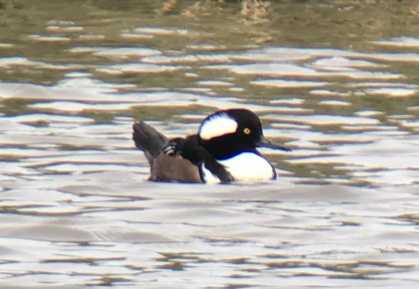

Hooded Merganser
Hooded Merganser - a smart drake, on Patsy's Reedbed
courtesy of Marcus Nash


Hooded merganser is a rare visitor from North America, with only 12 accepted records, although no occurrences before 2000 were accepted. The situation is complicated by the fact that it is very common in captivity and escapes are frequent.

The Titchwell bird showed no signs of having been in captivity - we couldn't see any rings on its legs and it was fully winged.


  • Not far behind in the pecking order was a lovely grey phalarope seen at Thornham Point, just west of the Titchwell reserve, on day 2.  We waited for a lull in the weather before heading out to the sea from the Visitor Centre and turning west to the point.  The phalarope was over at the back of the pool at first, picking around in the samphire. Then it waded into the water and started swimming around, eventually coming right down to the near edge, in front of us.

grey phalarope at Thornham Point

courtesy of Marcus Nash
It was a young bird, a first winter, with some new grey feathers on its back but still with retained darker juvenile feathers on the back of its neck and wings. We could even make out the remains of the creamy orange wash on the front of its neck.
Grey Phalaropes breed in the high Arctic and spend the rest of the year out at sea, migrating down to the coast of South Africa for the winter. They are very prone to be being blown inshore on autumn storms, when they are scarce visitors here. A great bird to see.

 
  • Last time, the yellow browed warblers were just arriving on the north Norfolk coast as our tour finished and I had to be content with a brief glimpse of one in Wells Woods.  Not so this time, they were well established and present in good numbers.   Seeing them was still difficult with the strong winds causing havoc but after a slow start I managed to get several good sightings at Sheringham cemetery, Walsey Hills NR and Holkham Woods.
 

yellow browed warbler
courtesy of Marcus Nash

Arriving from their breeding grounds in the dense forests that stretch from the Urals to eastern Siberia, yellow browed warblers touch down in British woods and scrub, invariably along the east coast, before continuing on a migratory route to who-knows-where. 
 
After first being recorded in Britain in Northumberland in 1838, numbers rose slowly each year to the 1960s when it was no longer regarded as an official rarity, having clocked up 300 sightings. The species is going through a quantum migratory shift. Vast numbers still head to South-east Asia each autumn but a small, slowly increasing vanguard is heading westwards. 
 
 
The best birding experience of the tour was not provided by any rare birds but by the humble siskins and chaffinches. 
  • On our last morning we noticed a huge movement of siskins going west as we were walking through Holkham Woods.  Over the next hour or so we estimated over 2000 had flown overhead and Marcus picked up a report from the seawatchers at Sheringham of over 3500 passing there in a 2 hour slot.  Never before had I seen so many siskins in the air!
  • No sooner had the flow of siskins abated when we noticed a similar build up of chaffinches, again flying overhead along the coast in a westerly direction and numbering at least 2500.  Not quite as many as the siskins but equally stunning and a joy to watch! 

VIZMIG at its very best!
 
 
Here are some of the remaining highlights:-
  • A cracking jack snipe on Snipes Marsh by the car park at Walsey Hills NR on day 3
Jack snipe at Walsey Hills
courtesy of Marcus Nash

  • We had superb views of bearded tits, less than 10 metres away, from the main path by the Island Hide at Titchwell on the last day.  We even had the rare sighting of a cetti's warbler flying with the bearded tits. In front of the hide,  we also had a very obliging water rail looking terrific in the late afternoon sunshine.
male bearded tit at Titchwell
courtesy of Marcus Nash

  • The pink footed geese numbers continue to increase as the autumn progresses!
Pink footed geese
courtesy of Marcus Nash
  • We went down to The Brecks again to see the stone curlews, as none of the rest of the group had seen them gathering communally before.  In all, we saw at least 28 but they were more distant than two weeks ago as they hunkered down to avoid the adverse weather. 
Stone curlews at The Brecks
courtesy of Marcus Nash

  • Among the other birds seen were ring ouzels (poor views I'm afraid), spoonbills, great white egrets, cattle egrets, a couple of yellowhammers, ruff and lots and lots of jays and goldcrests.
  • At Titchwell, just before lunch on day 2, we had the bonus of seeing a water shrew on the path in front of us, feeding on the remains of snails which had been crushed underfoot. They are normally quite secretive, so it was amazing to see one out in the open like this, seemingly completely unconcerned by all the people passing by.
Water shrew at Titchwell
courtesy of Marcus Nash


Another truly great tour, in the most challenging of conditions.  Marcus organised things so that we were actually travelling in the minibus when the weather was at its wettest.